

The SPACE FOR OUR PLANET exhibition is open to the public until November 2nd, at Praça Gonçalo Velho Cabral – Ponta Delgada. The exhibition looks at the role that Space plays in the United Nations Agenda for 2030. The objective is to raise awareness of how Space provides innovative solutions and contributes to achieving the 17 Sustainable Development Goals (SDGs). Created in 2021, the exhibition, made up of 40 panels, has been on display in some of the main world capitals such as New York, Brussels or Paris, and associated with major strategic events, such as Expo Dubai, showing real testimonies from academics, fishermen, astronauts , students, teachers or scientists, among others, including the testimony of four Portuguese people. Each of the testimonials is presented by the portrait of one of the “actors of change” who uses or benefits from technology or space applications that allow us to build an increasingly sustainable future.
The exhibition is the result of a partnership between the Office of the Regional Undersecretary of the Presidency, through EMA-Espaço, the POnta Delgada City Council, and the Portuguese Space Agency – Portugal Space.
Photo credits: João Freitas (GRA)
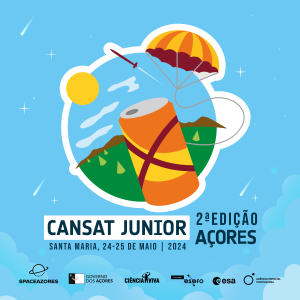
This competition is aimed at the basic education students (middle school) from all schools in the Autonomous Region of the Azores, with the main objective of providing young participants with contact with basic but very practical science and engineering applications in a “real” project. absolutely exciting and impactful in the development of scientific, technical, communication, teamwork and problem-solving skills.
WHAT IS A CANSAT?
A CanSat (“Can” = can + “Sat” = Satellite) is an educational project created in Portugal by ESERO and Ciência Viva, aimed at students in the 3rd basic cycle. It is a simplified version of the European Space Agency (ESA) CanSat project, and consists of building a functional model of a microsatellite capable of measuring atmospheric parameters and sending telemetry to a base station. The CanSat is launched from a certain altitude and during the descent, controlled by a parachute built by the students, it transmits data on temperature, air pressure and altitude, to the base station made up of an antenna, also built by the students, connected to a receiving device and a computer.
WHO CAN PARTICIPATE?
Teams of students (minimum of 3 and maximum of 6 members) guided by a teacher. In this 2nd edition, a team that has already participated must include at least one student who has never participated in the CanSat Junior project. A school can register more than one team.
SELECTED TEAMS
>> Corvinos – EBS Mouzinho da Silveira (Corvo)
>> Team GoForIt – EBS das Flores (Flores)
>> Eagles – EBS das Lajes (Pico)
>> Astro(Wo)men – EBS da Madalena (Pico)
>> Cosmos do Topo – EBI da Vila do Topo (São Jorge)
>> VelasSpaceSat – EBS de Velas (São Jorge)
>> PaxiGrace – EBS dda Graciosa (Graciosa)
>> Starlight – Colégio do Castanheiro (São Miguel)
>> Vaquinhas Voadoras – EBI de Ginetes (São Miguel)
>> Peixinhos Espaciais – EBI de Rabo de Peixe (São Miguel)
>> RobotMinds – ES da Ribeira Grande (São Miguel)
>> Astrojovens – ES de Lagoa (São Miguel)
>> SpaceNerds – ES Domingos Rebelo (São Miguel)
>> Buteospace – EBS Bento Rodrigues (Santa Maria)
IMPORTANT DATES
>> Until November 30, 2023 – Registration and submission of videos. CONCLUDED
>> December 4th to 8th, 2023 – Team selection. CONCLUDED
>> December 11, 2023 – Communication of the selection results to the supervising teachers. CONCLUDED
>> February 3rd, 2024 – Teacher training workshop, on São Miguel Island. CONCLUDED
>> May 24th and 25th, 2024 – Final of the CanSat Junior Azores competition, on Santa Maria Island. CONCLUDED
2ª EDITION IN NUMBERS
>> 7 Islands present
>> 14 Teams
>> 94 Students (41 Girls and 39 Boys)
>> 14 Teachers
PARTNER ENTITIES
ORDER OF LAUNCHES AND PRESENTATIONS
REVIEW THE 1ST EDITION OF CANSAT JUNIOR AÇORES
HIGHLIGHTS:
Photos day 1 (Credits Vânia Andrade)
Photos day 2 (Credits Vânia Andrade)
Videos day 1 and 2 (Credits Pepe Brix)
Video summary (Credits Pepe Brix)
The office of the Regional Undersecretary of the Presidency, through the Azores Mission Structure for Space, held a public session to launch World Space Week 2023, in the Ponta Delgada Public Library Auditorium, on October 4th, at 10:00 am, which was attended by Cláudio Gomes, Physicist and National Coordinator of World Space Week, and Earth Observation specialist Mariana Ávila, from the AIR Centre.
World Space Week is an international celebration of science and technology, and their contribution to improving the human condition.
The United Nations General Assembly declared in 1999 that World Space Week will be held every year from October 4th (the day marking the launch of the first man-made satellite, Sputnik 1, in 1957) to October 10th. (date of signing of the Outer Space Treaty, in 1967).
The event, open to the public, aimed to disseminate and promote scientific culture dedicated to young people of school age, as a way of disseminating the importance of space exploration and the use of space technologies for the benefit of humanity.
This year, World Space Week pays particular attention to the entrepreneurship component in the space sector.
The 30 finalists of the second edition of the “Zero-G Portugal – Astronaut for a Day” initiative, promoted by the Portuguese Space Agency (Portugal Space), have already completed their first parabolic flight experience, where they had the opportunity to experience the sensation of microgravity on board of an Airbus A310 operated by Novespace, which took off from Air Base nº. 11 of the Portuguese Air Force, in Beja.
The flight involves a series of maneuvers on a parabolic trajectory, which begin to be carried out when the plane reaches an altitude above 6,000 meters. For around an hour, 15 parabolas are performed where it is possible to experience a sensation of zero gravity. After all, on this flight young people have the opportunity to experience between five and six minutes of microgravity identical to what astronauts feel when they are in space. This group of young people from primary and secondary education, made up of 20 boys and 10 girls from various parts of the country, included, for the first time, students from the Azores. There were 5 Azorean finalists, 2 from the island of Santa Maria and 3 from Terceira island, selected from more than 500 candidates and after 4 demanding selection phases.
The Government of the Azores, through the Office of the Regional Undersecretary of the Presidency and the Azores Mission Structure for Space, joined the Portuguese Space Agency in disseminating this initiative among the region’s educational community by holding dissemination and awareness sessions in schools, giving expression to the strategy of creating a cultural and educational framework as a foundation for the development of the Azores’ space ecosystem.
Photo credits: Portuguese Space Agency (Portugal Space)
After a selection process that put several skills to the test, 30 young Portuguese students will have the opportunity to make a parabolic flight. For the first time there are candidates from the Azores, Madeira, Beja and Faro.
After four months of elimination rounds, the 30 finalists of the 2nd edition of Zero-G Portugal – Astronauta for a Day were selected. The initiative, promoted by the Portuguese Space Agency, will once again take primary and secondary school students on a parabolic flight aboard the Airbus A310, from the French company Novespace. The flight, departing on September 3, from Air Base No. 11, in Beja, will allow the crew to experience the zero gravity sensation that astronauts feel in Space.
Of the 30 selected participants, 20 are boys and 10 are girls. As for the origin of the finalists, this year’s edition of the initiative registered a greater geographic representation: for the first time, there are finalists coming from the Autonomous Regions of the Azores (3 from Terceira island and 2 from the island of Santa Maria ) and from Madeira, from Faro and Beja, but also Lisbon, Santarém, Aveiro, Braga, Coimbra, Leiria, Braga, Porto and Setúbal.
In terms of distribution by years of schooling, 27 finalists are attending Secondary Education (14 are in the 10th grade; 13, in the 11th grade) and 3 are students in the 3rd cycle of Basic Education (two in the 9th grade , one from the 8th grade).
The Azores Mission Structure for Space participated in the dissemination of this initiative among the Azorean educational community, with the Portuguese Space Agency.
Photo: Portuguese Space Agency
The 1st edition of CanSat Junior Açores took place on the 26th and 27th of May, an organization of the Government of the Azores through the Office of the Regional Undersecretary of the Presidency/EMA-Espaço, Ciência Viva, ESERO Portugal, and the Portuguese Space Agency. For two days, around 100 students from 7 islands lived an unforgettable scientific and technological adventure on the island of Santa Maria, where they tested and analyzed data from their microsatellites launched by a drone.
They were moments of great anxiety but also of great joy, fun, learning and knowledge sharing.
All were winners, but there were 3 teams that stood out:
1st place: “Cagarros” – EBS Santa Maria
2nd place: “SpaceNerds” – ES Domingos Rebelo (São Miguel)
3rd place: “Azores at Space” – ES de Lagoa (São Miguel)
Well done everyone, students and teachers, for your work!
See you next year!
SCHEDULE FOR THE 1st EDITION OF CANSAT JUNIOR AÇORES
HIGHLIGHTS:
SapoTEK: Um satélite pode caber numa lata de refrigerante? CanSat chegou aos Açores e quer ficar
RTP Açores: CanSat Junior Açores
SPACEAZORES: Equipa “Cagarros” obtem 2º lugar na final nacional do CanSat Junior